
Parliament on Thursday cleared the decks for the rollout of the historic Goods and Services Tax from July 1 as it approved four supporting legislations to usher in the one-nation-one-tax regime.

Taxmen have come across instances where global firms - charged a withholding tax of 6 per cent - are underreporting the exact income they earned from an Indian user.

"To begin with, people could face some difficulties because any changeover has its own problems. But it will settle down and the country will benefit from the new indirect tax regime," Jaitley said at an event organised by ABP News.

The prime minister is aware that whatever be its consequences, a new taxation regime cannot be launched closer to the general elections in 2019. Thus, any date after April 2017 for the launch of GST is risky, says A K Bhattacharya.
The government now ends its mandate with reaffirmation in the vote-on-account of the same goals, for which it claims to have a clear line of sight.

Many countries advised the return the high-denomination notes to the central bank for destruction, but these continued to be legal tender. This and the introduction of a new Rs 2,000 note in India are the two major differences between Indian demonetisation and those of other countries.

'By taking fingerprints, iris scans and other details of citizens, the State is becoming the custodian of its people.' 'The State can use this data according to its whims and fancies, which is not good in a democracy.' 'When the State looks at all the activities of its citizens, it becomes a police State.'

Criticising various provisions in the proposed GST regime, Moily said it will be a "technological nightmare" and the anti-profiteering provisions in it are "far too draconian."
India is on the brink of overhauling its tax system, implementing the BEPS project and seeing a further evolution of the GST at the same time as a general election. This makes 2019 an exciting and challenging year, note Maulik Doshi and Jigar Doshi.

Single window clearances for realty must.

States' demand of compensation from Centre for loss of tax revenue not on agenda.
The Budget has relaxed a few safe harbour rules that aim to make it easier for fund managers overseeing offshore India-focused funds to relocate to the country.

A moderate GST rate obviates the need for the two-rate structure.

Sitharaman further said that to mitigate genuine difficulties of start-ups and their investors, government has decided to withdraw angel tax provisions for them.

Tax Guru Anil Rego answers your personal income tax queries.

If Modi's truly a reformer and a believer in minimum government, he would bury the Vodafone ghosts now. He would also then go to Bihar, campaigning on his politically controversial reforms. Both will need him to dip deep into his accumulated political capital and risk it, suggests Shekhar Gupta.

To begin, the Budget has no doubt attempted to address uncertainty.

Consensus seems a problem before the current session of Parliament ends.

The GST has been a great achievement, but it does suffer from weaknesses, says Chief Economic Adviser Arvind Subramanian.

It is welcome that the government tried to make its intentions clear last week - especially as risk concerns return to global markets.

Rules applicable from April 1, 2014; investors who have already redeemed will also have to pay tax


Unless the judges factor in the ungovernability of technologies and their beneficial owners, present and future Presidents, prime ministers, judges, legislators and officials handling sensitive assignments may become redundant with reference to their age-old roles for securing 'national resources and assets', warns Dr Gopal Krishna.

'The idea of Hindu Rashtra is one of the most inclusive concepts.'

The government last month introduced the GST Bill in Parliament.

The premium on insurance policies will get costlier by 3 per cent to 7 per cent, depending upon the rate fixed by the GST Council from April 1, 2017, says Harjot Singh Narula.

Concluding the three-part series, Paranjoy Guha Thakurta says that the black money law is likely to fail because of the ineptness of India's investigative and enforcement agencies.


There will be a review of employee compensation arrangement in the light of the new rules.

Prime Minister Narendra Modi gave the vote of thanks to the President's speech on the opening day of the Budget session.

The government has provided a long-term vision.

The Budget sets out a comprehensive vision.

A K Bhattacharya digs into the yet-to-be-public report on ways to curb black money and finds out that Modi's next moves could include action on dabba trading, hawala, and education.
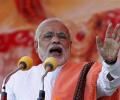
Most top industrialists rate PM's first 100 days in office as 'good', primarily due to his intentions, not concrete policy measures.

Softening the demonetisation blow, the Budget for 2017-18 on Wednesday halved the tax to 5 per cent on incomes up to Rs 500,000 but proposed a new surcharge of 10 per cent on incomes between Rs 50 lakh and Rs 1 crore and raised duties on cigarettes and pan masala while stepping up allocations for infrastructure, rural, agriculture and social sectors.

Budget might turn out to be neutral for the sector.

Finance Minister Arun Jaitley presented the Union Budget.

Indian economy about to take-off

'The voter thinks that the State is not going to impartially deliver services, provide justice, basic law and order, social insurance -- so as a voter it's very rational that I may choose a criminal who will help me navigate the State.' 'A weak State allows a criminal politician to be the person who provides that guarantee to mediate whatever problem the citizen has with the State.'

'Let us also not expect that there will be a clean break with the past, much though the new government might like to think about it. In a functional democracy that is neither feasible nor desirable. But basic change it must be,' says Shreekant Sambrani.
